Google's AI Dominance: A 10-Point Strategic and Competitive Analysis
A breakdown of the 10 reinforcing pillars that create Google's formidable AI advantage.
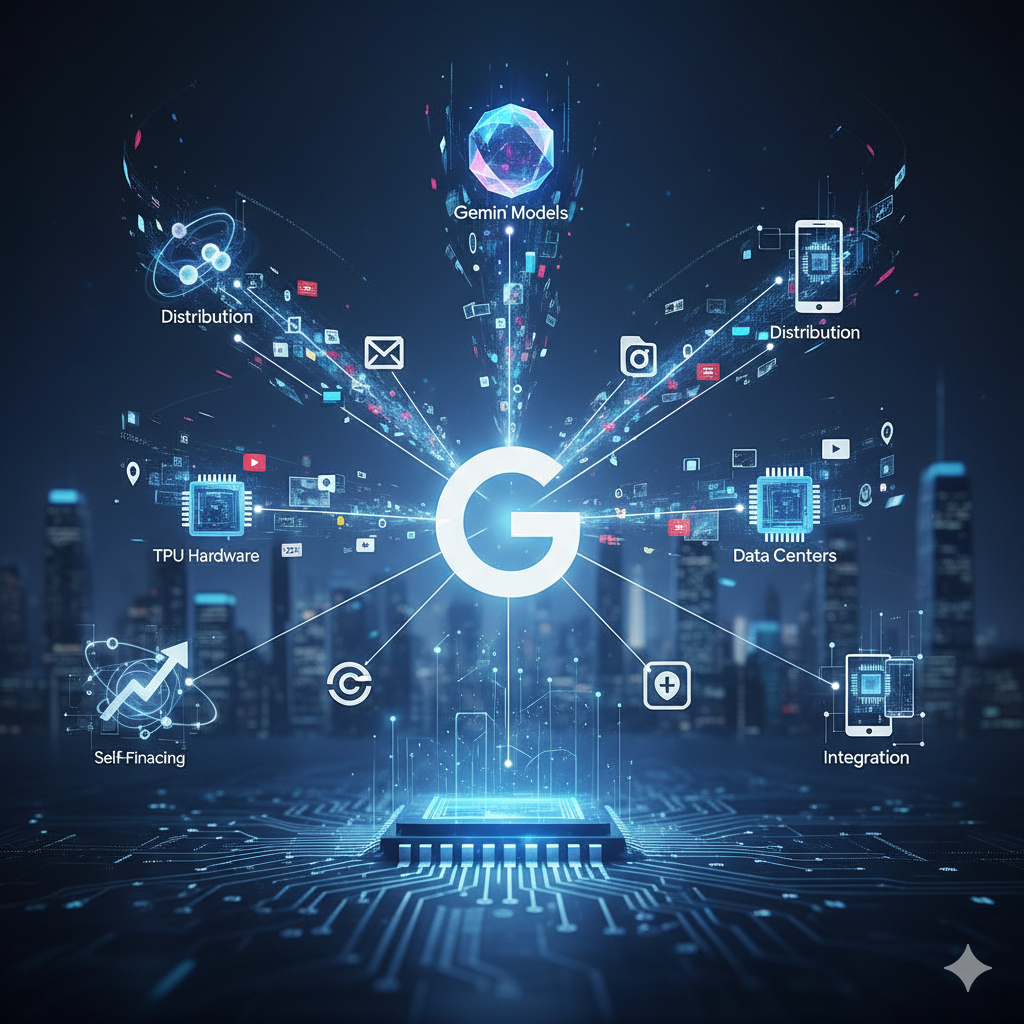
In the global race for artificial intelligence supremacy, many contenders are vying for the top spot. Yet, when you look closely at the strategic assets of Alphabet's Google, a compelling argument emerges: their leadership may not be a question of "if," but "when."
Google has meticulously built a set of reinforcing advantages that create a near-perfect ecosystem for AI dominance. Here is a breakdown of those 10 strategic pillars.
1. The Foundation: Pioneering Research
Google Research effectively set the stage for the modern AI boom. Their 2017 paper, "Attention Is All You Need," introduced the Transformer architecture, the foundational technology behind models like GPT and Google's own Gemini. They didn't just join the race; they built the track.
Competitive Analysis
- OpenAI: (Pro) Has been the industry's single greatest accelerant. Their research on InstructGPT (RLHF), DALL-E, and the rapid, product-focused iterations of the GPT series has consistently set the public benchmark.
- Anthropic: (Pro) Leads the industry in safety research. Their "Constitutional AI" framework is a unique and valuable contribution, building safety into the model's core rather than bolting it on as an afterthought.
- Meta: (Pro) Their decision to open-source the Llama model family has been a seismic event. It catalyzed the entire open-source community, creating a powerful, decentralized counter-force to the closed-model approach.
- Competitor: (Con) OpenAI, once a research beacon, is now a "closed" lab. Other players like Anthropic and Deepseek, while excellent, are often reacting to the research agendas set by Google and OpenAI rather than defining new foundational-level primitives.
2. The Engine: A World-Class Model Suite
Building on that foundation, Google has developed its own cutting-edge AI suite, headlined by the Gemini family of models. As a natively multimodal system, it was designed from the ground up to understand and operate across text, images, audio, video, and code simultaneously.
Competitive Analysis
- OpenAI: (Pro) GPT-4o is the undisputed king of the hill for combined performance, low latency, and advanced multimodality. It remains the benchmark that all others are measured against.
- Anthropic: (Pro) The Claude 3 family (Opus, Sonnet, Haiku) is a direct, best-in-class competitor. Opus surpassed GPT-4 in many benchmarks, proving there is more than one lab capable of building S-tier models. Their 1-million-token context window is a key enterprise differentiator.
- Competitor: (Con) This is a game of families. OpenAI is less a "suite" and more a "duo" (GPT-4o for speed, GPT-4 Turbo for power), lacking a true on-device "Nano" equivalent. Anthropic and Meta also lack a true, optimized-for-silicon, on-device model, making them 100% dependent on cloud connectivity.
3. The Hardware: Custom, Optimized Silicon
A-level software runs best on A-level hardware. Google understood this early on, developing its own Tensor Processing Units (TPUs). These smart chips are custom-built and optimized specifically for their machine learning workloads, giving them a significant performance and efficiency advantage. While other compute data centers are dependent on NVIDIA's availability and timeline, Google relies on its own Ironwood chip.
Competitive Analysis
- The NVIDIA Dependency: (Con) OpenAI, Anthropic, and Meta are almost 100% dependent on NVIDIA. This is their single greatest strategic vulnerability. They are at the mercy of NVIDIA's brutal 80%+ gross margins, constrained supply, and public roadmap.
- Microsoft/Amazon: (Pro) The cloud giants know this is a weakness. Microsoft is building its "Maia" AI accelerator, and Amazon has its "Trainium" and "Inferentia" chips (which Anthropic uses). This is a good hedge, but these programs are years behind Google's mature, decade-old TPU division.
4. The Fortress: Sovereign Infrastructure
Where does this all run? On Google's own massive, global data centers. By hosting on their own infrastructure, they control for cost, security, scalability, and speed, eliminating dependence on other cloud providers for their most critical asset.
Competitive Analysis
- The Tenant vs. The Landlord: (Con) OpenAI and Anthropic are tenants. OpenAI is a tenant in Microsoft Azure. Anthropic is a tenant in Google Cloud and AWS. They have no "sovereign" infrastructure. This exposes them to platform risk.
- Microsoft: (Pro) Microsoft Azure is a true fortress, a direct equivalent to Google's. This is Microsoft's advantage, which it lends to OpenAI.
- Meta: (Pro) Meta is the only other true "sovereign" player, with its own massive data centers. This makes them a far more durable, long-term competitor than the "tenant" labs.
5. The "Unfair" Advantage: An Unmatched Data Moat
AI models are trained on data, and Google's data is unparalleled:
- Search: A real-time map of human curiosity.
- Maps: A rich model of the physical world.
- Books: A digitized library of human history.
- And the crown jewel: YouTube. The world's largest video platform is a limitless well of video frames, audio, transcribed text, users views, likes and comments!
Competitive Analysis
- The Data Desert: (Con) OpenAI and Anthropic are facing a "data desert." They have already trained their models on the "Common Crawl." The question is: what's next? The internet is now being polluted by AI-generated content.
- OpenAI's Strategy: (Con) They are forced to pay for data, striking expensive, piecemeal deals with publishers (like Axel Springer, AP, Reddit). This is not a sustainable, scalable long-term strategy compared to Google's organic, real-time data firehose.
- Microsoft/Meta: (Pro) This is where the other giants shine. Microsoft has GitHub (code) and LinkedIn (professional). Meta has the largest social-human interaction dataset from Facebook, Instagram, and WhatsApp.
6. The Horizon: Next-Generation Computing
Google isn't just focused on today's hardware. Its investments in Quantum Computing, highlighted by the Willow chip's recent breakthroughs in error correction, show a clear focus on the next paradigm of computation.
Competitive Analysis
- Microsoft: (Pro) Microsoft Azure Quantum is a formidable, direct competitor, playing the same long-term game.
- OpenAI/Anthropic/Meta: (Con) These labs have zero credible quantum programs. They are 100% focused on scaling today's deep learning architecture. Google and Microsoft are the only players in this race also building the next racetrack.
7. The Flywheel: Unmatched Distribution
A powerful AI is useless without distribution. Google can integrate its AI into the daily lives of billions of users overnight through its dominant ecosystem:
- Google Search
- Gmail, Docs, Sheets, & Slides
- Google Maps & Translate
- Android
Competitive Analysis
- Microsoft: (Pro) This is Microsoft's superpower. They have an equally powerful flywheel for the enterprise: Windows, Microsoft 365 (Office, Teams), and Edge. Their ability to embed "Copilot" into this stack is their core strategy.
- Apple: (Pro) Apple has the wealthiest, most-engaged user base on iOS and macOS. Their "Apple Intelligence" strategy will be a dominant force in on-device distribution.
- OpenAI/Anthropic: (Con) They have no native distribution. Their "product" is a website (ChatGPT) and an API. They are completely reliant on partnerships (Microsoft, Apple, Amazon) to reach end-users. This makes them a component, not a platform.
8. The Fuel: A Self-Financing Juggernaut
Finally, the entire endeavor is self-financing. Google's existing successful products generate such massive cash flow that they can fund this capital-intensive R&D without blinking. (See: Alphabet Investor Relations).
Competitive Analysis
- Microsoft/Meta/Apple: (Pro) Same. Their core businesses (Cloud/Software, Ads, Hardware) are cash-printing machines that fund their AI ambitions.
- OpenAI/Anthropic: (Con) They are not self-financing. They are burning cash at an astronomical rate. Their revenue is high, but their compute costs are higher. They are 100% reliant on continuous, massive infusions of investor capital (from Microsoft, Amazon, Google) to survive.
9. The Monetization: Enterprise Entrenchment
This is the profit engine. Google is embedding Gemini directly into its high-margin Gemini Enterprise and Vertex AI platforms. This allows companies to build AI agents on their own data (across Workspace, MS 365, etc.), creating a secure, "sticky" ecosystem that turns AI novelty into a recurring revenue stream.
Competitive Analysis
- Microsoft: (Pro) This is Microsoft's strongest pillar. "Copilot for Microsoft 365" is the killer app for the enterprise. They own the "default" productivity stack for the Fortune 500. Google is playing catch-up here.
- Amazon (for Anthropic): (Pro) Amazon's "Bedrock" service makes it simple for its massive AWS customer base to use Anthropic's Claude models, giving Anthropic instant enterprise distribution.
- OpenAI: (Con) They are in channel conflict with their biggest partner. Why pay for "ChatGPT Enterprise" and "Microsoft Copilot"? Microsoft is clearly prioritizing its own "Copilot" brand, reducing OpenAI to an ingredient.
10. The "Edge": Platform-Native Integration
This goes beyond simple distribution. Google is embedding Gemini at the operating system level. This includes Gemini Nano running on-device on Android for speed and privacy, and deep, conversational integration into core apps like Google Maps, making AI an ambient, agentic part of a user's life.
Competitive Analysis
- Apple: (Pro) Apple is the king of the edge. Their entire "Apple Intelligence" strategy is built on powerful, on-device models running on their own M-series and A-series silicon. This is their core advantage.
- Microsoft: (Con) They are trying to build this with "Copilot+ PCs," but they are reliant on a partner (Qualcomm) for the chips. They don't have the full-stack, silicon-to-OS integration that Apple (iOS) and Google (Android) have on mobile.
- OpenAI/Anthropic: (Con) They have no edge strategy. They are 100% cloud. This is a fatal flaw in a future that will be dominated by hybrid (on-device + cloud) AI.
Strategic Overlap Map
The matrix below quantifies the scores, but this strategic map visualizes the fundamental market structure. The "Full-Stack Giants" (Google, Microsoft, Apple) have vast, overlapping territories, controlling everything from silicon to end-user distribution. Meta is also a sovereign giant, but with a different focus.
The "Pure Model Labs" (OpenAI, Anthropic) are powerful but "landlocked," existing as high-value tenants within the giants' ecosystems. This visualizes their dependency on the very companies they also compete with.
Conclusion: The AI Player Matrix
When you assemble these pieces, the picture is clear. Google controls the foundational research, the models, the custom chips, the data centers, the unparalleled data, the distribution network, the long-term R&D, and the cash to fund it all. Now, they are locking in that advantage with a powerful enterprise monetization engine and a deep, platform-native integration strategy.
This analysis shows that while many labs can build a "great model," only a handful of companies can fight a full-stack war. Google's primary weakness is being #2 in the enterprise cloud. Its competitors' weaknesses are far more structural: dependencies on hardware, infrastructure, distribution, and even funding.
Google is one of only two companies (along with Microsoft) that has a credible, top-tier offering in every single category. The others are "pure" players with critical, and potentially fatal, dependencies.
Here is a summary scorecard:
| Feature | Google Gemini | Microsoft Copilot | OpenAI ChatGPT | Anthropic Claude | Meta Llama | Apple Apple AI |
|---|---|---|---|---|---|---|
| 1. Foundational Research | 10 | 8 | 10 | 9 | 9 | 6 |
| 2. Model Suite Quality | 9 | 9 | 10 | 9 | 8 | 7 |
| 3. Custom Hardware (Silicon) | 10 | 6 | 0 | 0 | 5 | 10 |
| 4. Sovereign Infrastructure | 10 | 10 | 0 | 0 | 9 | 10 |
| 5. Proprietary Data Moat | 10 | 9 | 3 | 2 | 9 | 9 |
| 6. Distribution Flywheel | 10 | 10 | 2 | 1 | 9 | 10 |
| 7. Self-Financing | 10 | 10 | 1 | 1 | 10 | 10 |
| 8. Enterprise Entrenchment | 8 | 10 | 4 | 5 | 2 | 6 |
| 9. On-Device ("Edge") | 9 | 6 | 0 | 0 | 2 | 10 |
| 10. Popularity (Mindshare) | 8 | 8 | 10 | 6 | 7 | 9 |
| Total Score /100 | 94 | 86 | 40 | 33 | 70 | 87 |
Analyst's Conclusion:
- Google: (Pro) Wins on the most integrated, full-stack, and durable model.
- Microsoft & Apple: (Pro) The only other true full-stack competitors.
- Meta: (Pro) A powerful "wild card" that controls its own stack but lacks enterprise distribution.
- OpenAI & Anthropic: (Con) Not durable, long-term companies. They are historically significant research labs that are 100% dependent on their cloud "landlords" (Microsoft, Amazon, Google) for their very survival. They are components in a larger machine, not the machine itself.
It is only a matter of "Time," and as we know, Time is Money.